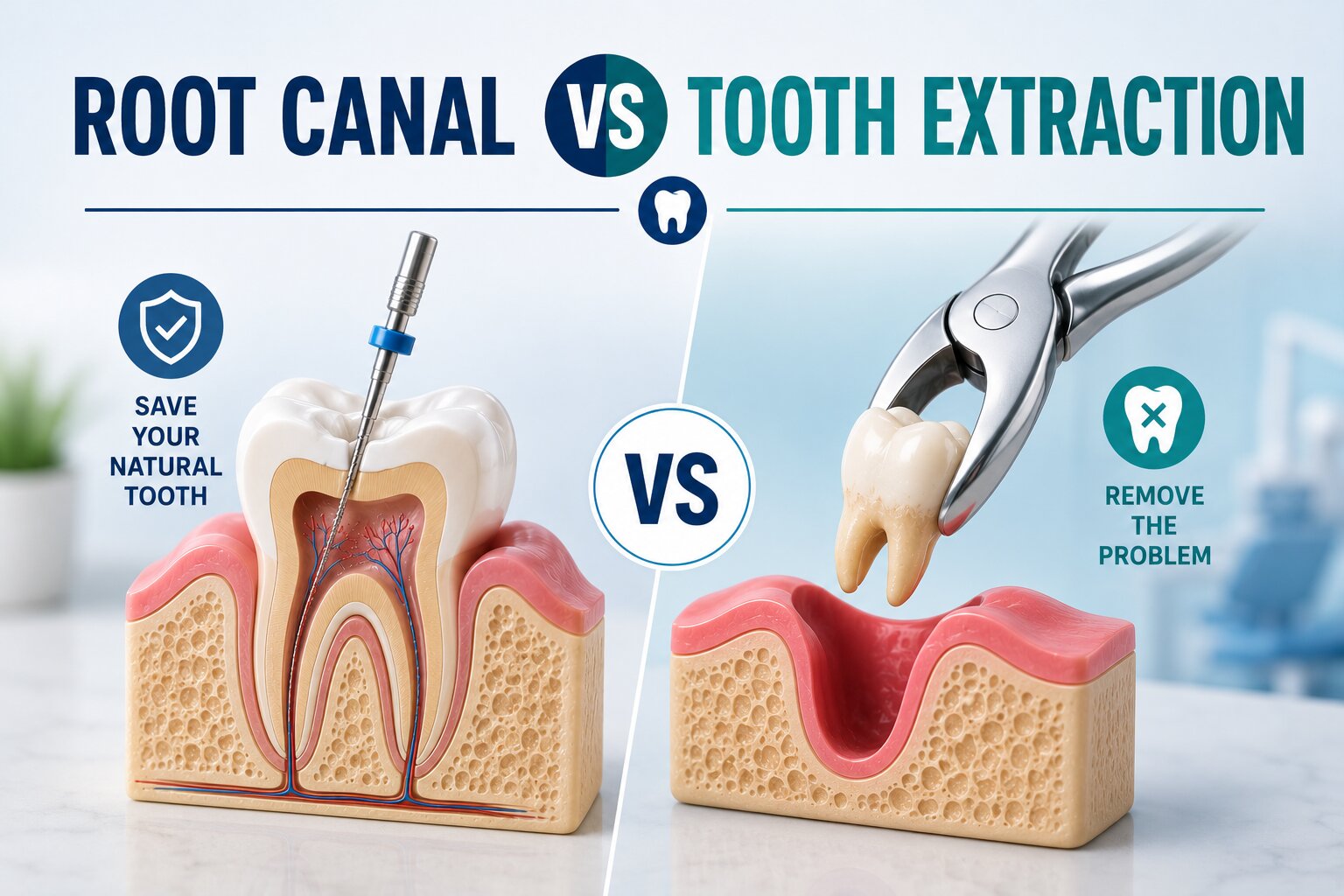
When a tooth becomes badly infected, cracked, or weakened by decay, the next step is not always obvious. You may hear two very different recommendations: treat the tooth with a root canal or remove it completely.
Both treatments can solve serious dental problems, but they do not lead to the same result.
A root canal is considered when the tooth still has enough strength to remain useful after the unhealthy tissue inside it is treated. Extraction becomes more likely when the tooth has lost too much structure or support to provide a dependable long-term result.
The real question is therefore not simply, “Which procedure is easier?” It is whether the tooth still has a realistic future in your mouth.
Why Would These Two Treatments Be Considered?
A healthy tooth is protected by hard outer layers, but there is softer tissue deeper inside it. That inner tissue can become irritated or infected when bacteria or damage reach far enough into the tooth.
This can happen because of:
- A deep cavity
- A serious crack
- An injury to the tooth
- Extensive previous dental work
- Breakdown around an older restoration
- Significant structural damage
At this stage, another simple filling may not be enough.
Some patients notice a persistent ache. Others develop pain when biting, sensitivity that lasts after hot or cold foods, gum swelling, or tenderness around one tooth.
There are also cases where the tooth looks badly damaged but causes surprisingly little pain.
That is why treatment decisions should be based on an examination rather than symptoms alone.
What Is the Goal of a Root Canal?
Root canal treatment is intended to keep a tooth that would otherwise remain painful, infected, or at risk of further trouble.
Instead of taking the tooth out, the dentist gains access to its internal space and removes the unhealthy tissue. The inside is then cleaned, prepared, filled, and closed.
Once this stage is complete, attention shifts to the outside of the tooth.
A tooth that required root canal therapy has often already lost some strength because of decay, fracture, or previous treatment. It may therefore need to be rebuilt with a filling or protected with a crown.
The important point is that the tooth itself stays in its original position.
What Changes When a Tooth Is Extracted?
Extraction means the tooth is removed from the jaw rather than repaired.
The area is numbed before the procedure. After the tooth is taken out, the socket begins its natural healing process.
This solves the problem of keeping a tooth that is no longer healthy enough to remain. However, it can create another question later: what should happen to the space?
The answer depends on which tooth was removed.
Some teeth may not require replacement. In other situations, leaving an open space can affect chewing or the way neighboring teeth function.
An extraction should therefore be viewed as both a treatment and, in some cases, the beginning of a new restorative decision.
The Most Important Question: Can the Tooth Still Be Rebuilt?
This is often the key difference between the two options.
Imagine two teeth with infections deep inside them.
The first tooth still has strong walls, stable roots, and good support around it. After treating the inside, there may be enough structure to rebuild the tooth and keep it functioning.
The second tooth may have decay extending far below the gumline, a severe fracture, or very little solid structure left.
Although both teeth have an internal problem, their chances of successful restoration are very different.
A root canal can treat diseased tissue inside a tooth. It cannot create strong tooth structure where too much has already been lost.
Situations Where Keeping the Tooth May Make Sense
Root canal treatment may be considered when the dentist believes the tooth can still provide reliable function after treatment.
This could include a tooth with deep decay that has reached the inner tissue but has enough healthy structure remaining.
It may also be an option after certain dental injuries or when a crack has affected the inside without making the entire tooth unstable.
The condition of the roots matters too.
A tooth needs adequate support from the tissues around it. Treating the inside is only worthwhile when the rest of the tooth has a reasonable chance of lasting.
Patients who keep the tooth may later need additional restorative dentistry to rebuild and protect it.
When Removal May Be More Practical
There are times when attempting to preserve a tooth may offer little benefit.
Too Little Tooth Remains
Severe decay can leave only a small amount of usable structure.
Even if infection inside the tooth could be treated, there still needs to be enough tooth left to hold a dependable restoration.
The Fracture Is Unfavorable
Not every cracked tooth has the same outlook.
A limited fracture may be manageable, while a crack extending deeply through the tooth or root can make long-term repair much less predictable.
Support Around the Tooth Has Been Lost
Teeth rely on healthy bone and gum tissues.
If a tooth has become very loose because much of that support is gone, treating its internal tissue may not address the larger problem.
Previous Treatment Has Failed Repeatedly
A tooth that has undergone extensive dental work may sometimes reach a point where another repair offers limited benefit.
In these circumstances, removal may provide a more sensible path forward.
What About Pain During the Procedures?
The reputation of root canal treatment causes many patients to worry before they even know whether they need one.
Both root canal therapy and extraction are generally performed after the treatment area has been numbed.
That means fear of the procedure should not be the main factor used to choose between them.
The experiences after treatment are different.
Following root canal therapy, the tooth may feel tender for a period and often needs its final restoration.
After extraction, the mouth needs time to heal where the tooth was removed.
Your dentist can explain what to expect based on the complexity of your individual procedure.
What Happens After the Root Canal Is Finished?
Treating the inside of the tooth is only part of the process.
The dentist must also decide how the remaining structure should be protected.
A tooth with significant loss of structure may benefit from a crown. Another tooth may require a different restoration.
The decision depends on where the tooth is located, how much remains, and the forces placed on it during chewing.
Once restored, the tooth still needs the same everyday attention as other teeth.
Regular brushing, cleaning between teeth, and professional examinations continue to matter.
What Happens After a Tooth Is Removed?
Early care focuses on allowing the extraction area to heal without unnecessary disturbance.
Later, the missing space can be evaluated.
If replacement is advisable, possibilities may include an implant, bridge, or removable restoration.
North Raleigh Dental Studio lists both oral surgery and restorative care among its dental services, allowing treatment planning to consider both removal and what may follow afterward.
Replacement is not automatically necessary after every extraction.
The location of the tooth, condition of nearby teeth, bone availability, bite, and personal needs all influence that decision.
Is Keeping the Natural Tooth Always Better?
Keeping your own tooth has clear practical benefits when that tooth can be restored successfully.
There is no new empty space to manage, and the tooth remains part of your existing bite.
However, “save the tooth” should not become an absolute rule.
A tooth with poor support, severe structural loss, or an unfavorable fracture may continue causing trouble despite extensive treatment.
The better goal is to preserve natural teeth when doing so has a reasonable chance of producing a stable result.
Which Treatment Costs Less?
It is easy to compare the price of a root canal with the price of an extraction and stop there.
That comparison may leave out important costs.
A root canal-treated tooth may need a crown or another final restoration.
An extracted tooth may later need replacement with an implant, bridge, or partial denture.
Therefore, ask for the expected treatment sequence rather than considering only the first procedure.
A useful financial comparison should include what happens immediately and what may be required afterward.
Questions Worth Asking Your Dentist
If you are being asked to choose between preserving and removing a tooth, consider asking:
- How much strong tooth structure is still present?
- Is the root in good condition?
- Is there a crack, and where does it extend?
- How well is the tooth supported by bone and gums?
- What would be needed after a root canal?
- What is the expected outlook if the tooth is saved?
- If it is removed, should the space be replaced?
- What would tooth replacement involve?
These questions help turn the discussion from “root canal versus extraction” into a more useful conversation about long-term function.
What Happens If You Avoid Making a Decision?
Tooth problems do not always progress in a predictable way.
Pain may disappear for a while, leading you to believe the problem has resolved.
A damaged or infected tooth can still continue changing even when symptoms become less noticeable.
Waiting may allow additional tooth structure to break down. An infection may also affect tissues around the root.
In some situations, a tooth that could once have been restored becomes much more difficult to save after further deterioration.
Recurring pain, swelling, or discomfort when chewing deserves evaluation rather than repeated temporary relief.
How Will Your Dentist Make the Final Recommendation?
A dentist does not decide between these treatments based on one symptom.
The complete picture matters.
The examination may look at:
- Remaining tooth structure
- Depth of decay
- Root condition
- Location of fractures
- Existing restorations
- Gum health
- Bone support
- Stability of the tooth
- Position within the bite
- Ability to restore the tooth afterward
Dental imaging can provide information that is not visible during a regular examination.
For more complicated teeth, another dental specialist may sometimes be involved before the final decision is made.
Root Canal or Extraction: Focus on the Future of the Tooth
Root canal therapy and tooth extraction are not competing versions of the same treatment.
One attempts to preserve a tooth that still has enough strength and support to remain useful. The other removes a tooth whose condition makes continued repair less practical.
That is why the correct choice varies from one tooth to another.
If the tooth has a sound foundation, treating and rebuilding it may be worthwhile. When major structural or supporting problems are present, removal may offer the more predictable result.
The best decision begins with knowing exactly what condition the tooth is in.
Have a Painful Tooth in North Raleigh?
Persistent tooth pain can make it tempting to choose whichever treatment seems fastest.
A proper examination gives you more useful information.
At North Raleigh Dental Studio, the condition of the tooth and surrounding tissues can be evaluated before treatment options are discussed.
If a tooth is painful, badly damaged, swollen, or uncomfortable when you chew, arranging an evaluation can help determine whether it has a realistic chance of being restored or whether removal should be considered.