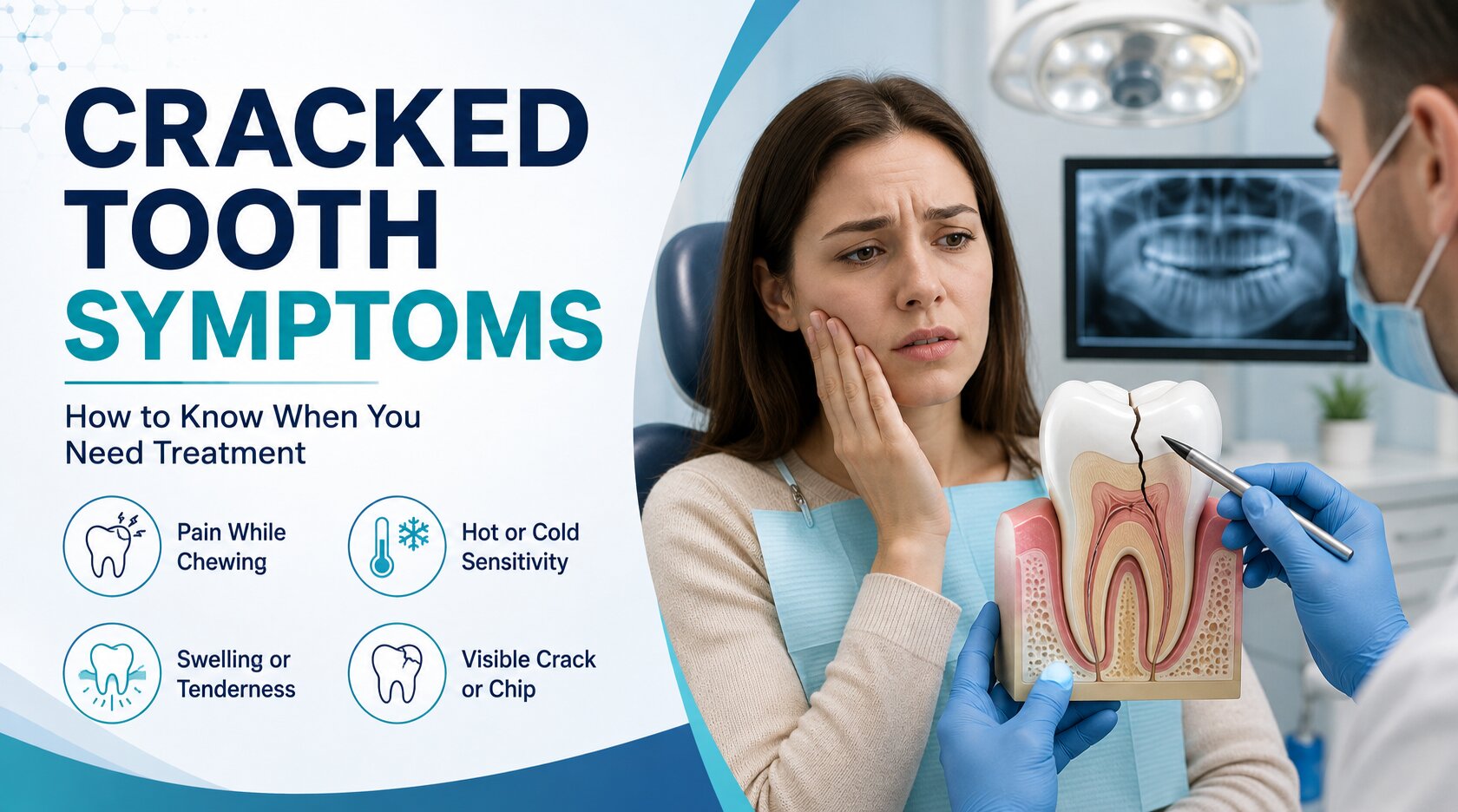
A tooth does not have to look broken to have a crack.
Sometimes, the damage is so small that you cannot see it in a mirror. You may only notice something is wrong when you bite into food, drink something cold, or put pressure on a certain part of the tooth.
For some people, discomfort comes and goes. For others, a tooth may simply begin feeling different from the surrounding teeth.
Because symptoms can be unpredictable, it is not always easy to judge how serious the damage may be.
Learning the possible signs of a cracked tooth can help you know when it is time to arrange a dental examination.
What Does It Mean to Have a Cracked Tooth?
A tooth becomes cracked when part of its structure develops a break or fracture line.
Some fractures involve only the outer enamel. Others extend farther into the tooth and may reach the dentin, pulp, root, or tissues supporting the tooth.
The location and depth of the crack play an important role in determining whether the tooth can be repaired.
A very shallow enamel line may need little more than observation. A deeper fracture may require a restoration, crown, root canal treatment, or another procedure.
One important point is that a true fracture in a tooth does not naturally seal itself again.
That makes early assessment useful, especially when symptoms continue returning.
What Can a Cracked Tooth Feel Like?
There is no single symptom that appears in every cracked tooth.
One person may feel a quick jolt when chewing. Someone else may first become aware of the problem after a cold drink causes an unusual reaction.
Some patients experience symptoms only when biting at a particular angle.
Others notice mild discomfort for several days, followed by a period when the tooth seems completely normal.
This changing pattern can make a damaged tooth easy to ignore.
However, repeated discomfort involving the same area is worth investigating.
1. Discomfort While Biting or Chewing
Pain that appears when you chew can be an important clue that a tooth has been damaged.
You might eat normally most of the time, but a particular bite suddenly causes a sharp sensation.
Some people feel discomfort while applying pressure. Others notice it as they release their bite.
A crack can allow part of the tooth to move slightly under pressure. This movement may irritate the more sensitive tissues within the tooth.
If you find yourself consistently chewing on the opposite side of your mouth, there may be a reason.
Avoiding the painful tooth may reduce discomfort temporarily, but it does not address what is causing it.
2. New Sensitivity to Hot or Cold Foods
Temperature changes can also reveal a problem.
A tooth that previously handled iced drinks without difficulty may suddenly react strongly to cold water. Hot coffee, soup, or tea may produce a similar response.
The sensation may disappear immediately after the trigger is removed. In other cases, discomfort can continue for longer.
Temperature sensitivity does not automatically confirm a crack.
Cavities, enamel wear, exposed roots, gum recession, and other conditions can also make teeth sensitive.
Still, when sensitivity develops mainly in one tooth and occurs alongside chewing discomfort, a dental examination is a sensible next step.
3. Pain That Is Difficult to Predict
One frustrating feature of a cracked tooth is that the pain may not be constant.
You could notice discomfort during lunch and feel completely normal by dinner.
The next day, the pain may return when biting something firm.
Because the discomfort may appear and disappear, finding the exact source of the problem can take careful examination.
Intermittent pain does not necessarily mean the tooth has recovered.
If the same area repeatedly causes trouble, make a note of what triggers it. That information can be useful during your dental appointment.
4. Sensitivity to Sweet Foods
Cold and heat are not the only possible triggers.
Some damaged teeth become uncomfortable when exposed to sugary foods or drinks.
You might notice sensitivity after eating dessert, drinking a sweet beverage, or chewing something sticky.
This type of discomfort can also occur with tooth decay, so it should not be used alone to identify a cracked tooth.
The important point is that a sudden change in one tooth deserves attention.
5. Gum Tenderness or Swelling
A crack that extends deeper into a tooth may sometimes lead to irritation or infection.
When this happens, the gum around the affected tooth may become sore, swollen, or tender.
You might also notice a bad taste, increasing discomfort, or pain that feels more persistent than before.
If swelling develops near the tooth, it is safer to have the area checked instead of simply waiting for it to improve.
Swelling can indicate that the problem has moved beyond a simple surface fracture.
6. When One Tooth Feels Unusual
A damaged tooth does not always produce strong or obvious pain.
Sometimes the first sign is simply that one tooth feels different.
It may feel slightly uncomfortable when you press on it with your tongue. Your bite may feel unusual. You may notice mild tenderness when chewing certain foods.
Even subtle differences deserve attention, particularly when the tooth has a history of:
- A large filling
- Previous dental treatment
- Recent injury
- Heavy grinding or clenching
- Biting something unexpectedly hard
An in-person dental check can help identify whether the symptoms come from a fracture or another oral health issue.
Why Can Teeth Crack?
Teeth are designed to handle daily chewing forces, but they are not immune to damage.
Some fractures happen instantly. Others form gradually.
In some cases, ongoing pressure slowly weakens the tooth until a fracture develops.
Several factors can increase the amount of stress placed on a tooth.
Biting Very Hard Foods or Objects
Hard candy, ice, popcorn kernels, and similar items can put considerable force on a tooth.
Sometimes a person bites down without realizing how hard an object is.
That sudden pressure may chip part of a tooth or create a fracture.
Using your teeth to tear packaging, open containers, or perform other non-eating tasks can also create unnecessary risk.
Grinding or Clenching Your Teeth
Nighttime grinding or clenching often happens without a person noticing it.
The repeated force can gradually wear the teeth and place extra strain on their structure.
Some people discover that they grind only after their dentist notices wear patterns or they begin experiencing jaw discomfort.
If grinding is suspected, your dentist can evaluate whether a protective appliance may be appropriate.
Injuries Affecting the Teeth
A fall, sports accident, collision, or direct blow to the mouth can place enough force on a tooth to damage it.
Sometimes the fracture is obvious immediately.
In other situations, the tooth may look normal at first and begin causing symptoms days or weeks later.
Any tooth that becomes painful after an injury should be evaluated.
Large or Older Restorations
Teeth with extensive fillings or restorations may have less natural structure remaining.
That does not mean these teeth will automatically fracture.
However, changes in the filling or surrounding tooth can affect how chewing forces are distributed.
Routine checkups allow a dentist to keep an eye on aging fillings, crowns, and the natural tooth around them.
Are There Different Types of Tooth Cracks?
Yes. Not every crack has the same significance.
Dentists consider where the fracture begins, how deep it extends, and whether different sections of the tooth have separated.
Craze Lines
Craze lines are very fine marks that remain within the outer enamel.
They are common in adult teeth and often cause no discomfort.
In many cases, they are more of a cosmetic concern than a serious structural problem.
Fractured Cusp
The raised portions on the chewing surface of a back tooth are called cusps.
A cusp may weaken and break, especially around a large filling.
The repair method depends on how much of the tooth has been affected and may include a filling or protective crown.
Cracked Tooth
A cracked tooth has a fracture that begins on the chewing surface and travels downward.
The tooth has not yet separated completely.
The depth of the fracture matters greatly.
A crack that stays within a restorable area may have a better outlook than one that travels far below the gumline.
Split Tooth
A tooth is considered split when the fracture has advanced enough to divide it into separate sections.
In these cases, preserving the whole tooth is often difficult.
The dentist will assess whether any stable portion can still be treated or whether removal is necessary.
Vertical Root Fracture
Some fractures begin in the root and extend upward.
These cracks can be difficult to detect because they may cause few symptoms at first.
A patient may first notice tenderness, gum swelling, or another problem near the root.
How Is a Cracked Tooth Diagnosed?
Finding a crack is not always as simple as seeing a visible line.
Your dentist will usually begin by asking questions about your symptoms.
You may be asked:
- When does the tooth hurt?
- Does cold trigger discomfort?
- Do you feel pain while biting?
- Does pain appear when you release your bite?
- Has the tooth recently been injured?
- Does the discomfort come and go?
The dentist can then examine the tooth and surrounding gum.
Bite tests, magnification, special lighting, periodontal measurements, and dental imaging may also be used depending on the situation.
Small fractures may not always show clearly on a standard X-ray, which is why symptoms and clinical examination remain important.
Is a Crown Always Necessary for a Cracked Tooth?
Not in every case.
The treatment choice depends on the depth and location of the damage.
A minor enamel line does not require the same care as a deeper fracture involving internal tooth tissue.
After evaluating the tooth, treatment options may include:
- Keeping a minor surface line under observation
- Repairing the area with dental bonding
- Replacing a damaged filling
- Restoring weakened tooth structure
- Covering the tooth with a dental crown
- Root canal therapy if the inner pulp has become involved
- Extraction when the remaining tooth cannot be restored successfully
The goal is to protect as much healthy tooth structure as possible while preventing further damage.
Will a Cracked Tooth Repair Itself?
Unlike bone, fractured tooth structure cannot naturally fuse back together after it has cracked.
Symptoms may become less noticeable for a period of time, but that does not mean the fracture has disappeared.
In some cases, a crack can gradually extend farther into the tooth.
If the fracture continues into areas that are difficult to repair, fewer options may remain for preserving the tooth.
That is one reason it is better to investigate recurring symptoms instead of waiting for severe pain.
When Should You Make a Dental Appointment?
You should consider scheduling an examination when the same tooth repeatedly causes discomfort.
Signs worth having checked include:
- Sudden discomfort when chewing on a particular tooth
- Pain that appears as you release your bite
- New sensitivity to cold or heat
- Discomfort that disappears and later returns
- Tenderness near a specific tooth
- Swelling around the gum
- A visible chip or fracture
- Pain that begins after an injury
- New symptoms around an older filling or crown
These symptoms can have several causes.
A dental examination helps identify which problem is actually responsible.
When Does Tooth Pain Need Urgent Attention?
Some situations require faster care.
Severe pain, rapidly increasing swelling, or signs of infection should not be ignored.
Facial swelling together with fever may indicate a more serious dental problem.
Difficulty breathing or swallowing together with facial or oral swelling requires urgent medical attention.
These symptoms should not be watched at home in the hope that they resolve.
Can You Lower the Risk of Cracking a Tooth?
It is impossible to prevent every dental fracture, but certain habits can reduce unnecessary pressure.
Avoid chewing ice and other extremely hard objects.
Do not use your teeth to tear packaging, open lids, or perform tasks meant for tools.
If you participate in activities where your mouth could be injured, appropriate dental protection may also be useful.
People who regularly grind or clench should discuss the issue with their dentist.
Regular dental visits can also help identify worn restorations, weakened teeth, or bite-related problems before they become more serious.
Pay Attention to Repeated Pain While Chewing
A fractured tooth may begin with mild or occasional symptoms rather than intense pain.
You might first notice that one bite feels uncomfortable. Another person may experience cold sensitivity or a tooth that simply feels different.
What matters most is whether the change keeps returning.
Repeated pain from the same tooth should not become something you simply work around by chewing on the opposite side.
At North Raleigh Dental Studio, a dental examination can help determine whether your symptoms are related to a crack, decay, an older restoration, or another dental condition.
If one of your teeth has started hurting when you chew, reacting to temperature, or feeling unusual, having it evaluated can help you understand what is happening and what treatment may be appropriate.