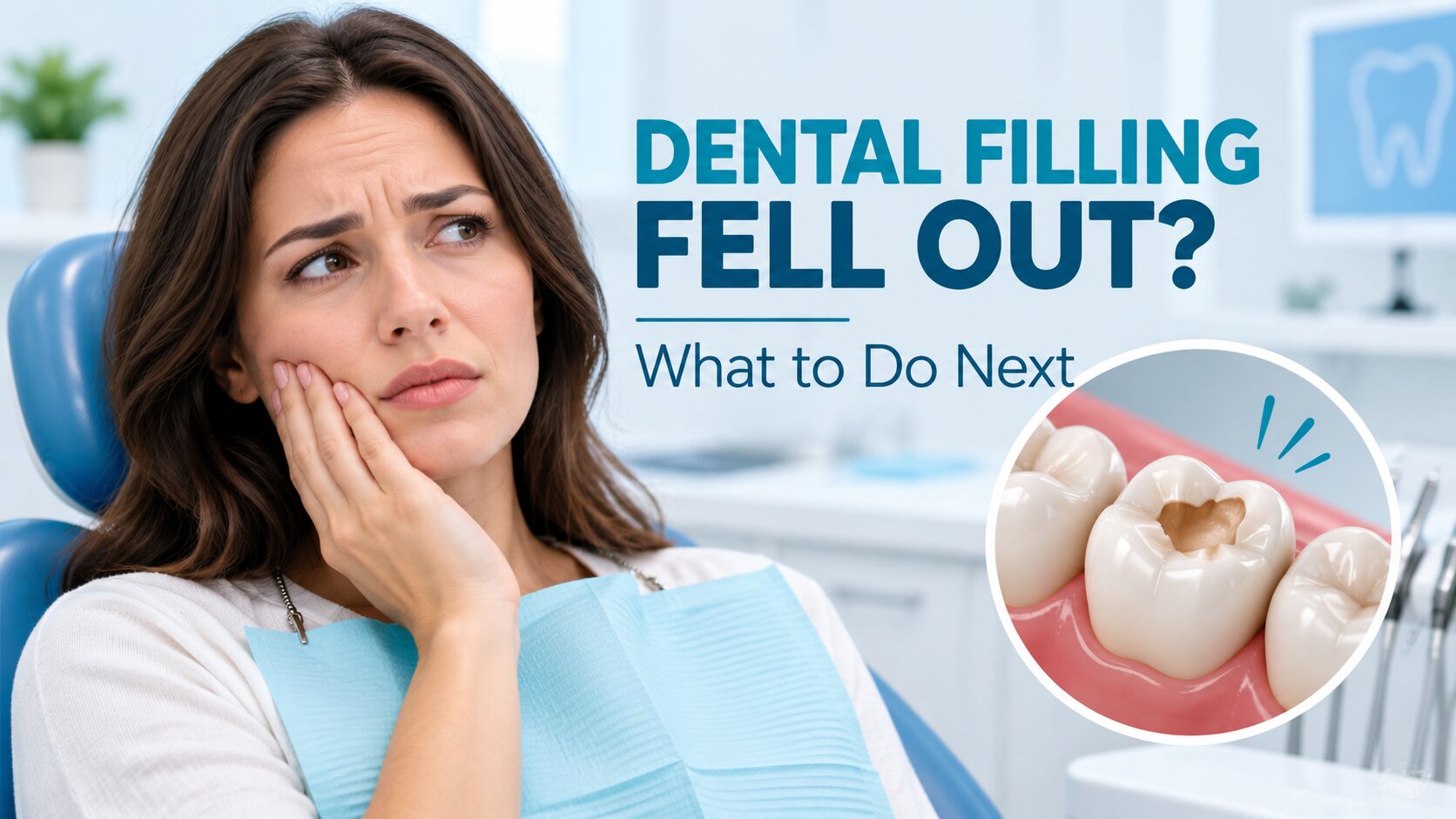
You bite into lunch and suddenly notice something hard in your mouth. A few moments later, one tooth feels different. There may be a small hollow area where part of the tooth used to feel smooth.
A dental filling may have come loose or fallen out.
This does not always cause immediate pain. Some people notice only a rough edge or an unfamiliar space. Others develop sensitivity when air, cold drinks, sweets, or chewing pressure reach the tooth.
The important thing is not to panic or ignore it.
A missing filling leaves part of the tooth without the protection it previously had. What happens next depends on why the restoration failed and how much healthy tooth remains.
First, Check What Actually Happened
Not every sudden change means the entire filling is gone.
Sometimes only a small piece breaks away. In other cases, the restoration stays partly attached but feels loose.
The tooth itself may also have chipped.
Use a mirror if you can see the area easily, but avoid pressing or picking at it.
You may notice:
- A new hole or depression
- A rough or sharp edge
- Food collecting in one spot
- Sensitivity that was not there before
- Discomfort when chewing
- A small piece of filling material in your mouth
- A tooth that suddenly feels uneven
Even if the area does not hurt, arranging a dental visit is still worthwhile.
What Should You Do During the First Few Hours?
The immediate goal is simple: keep the area clean and avoid putting unnecessary force on the tooth.
Rinse the Area Gently
Food may become trapped where the filling was.
Rinse your mouth with lukewarm water to clear loose debris. Avoid extremely forceful rinsing if the area feels tender.
You can continue brushing, but use controlled pressure around the affected tooth.
Be Careful When Chewing
Try not to use that tooth for hard or sticky foods until it has been examined.
A tooth that has lost a restoration may have thinner or weaker sections that are easier to damage under pressure.
Choose softer foods temporarily and use another part of your mouth for heavier chewing.
Notice What Triggers Sensitivity
Cold water may suddenly feel uncomfortable.
Sweet foods, hot drinks, or direct pressure can also create a response.
Avoiding those triggers for a short period can make the tooth easier to manage until your appointment.
If the tooth becomes severely painful rather than simply sensitive, contact your dentist promptly.
Should You Try to Put the Filling Back?
Usually, no.
A filling is different from a crown. It is shaped and bonded directly into the prepared part of the tooth.
Once it has broken free, placing the piece back into the space will not recreate the original seal.
Do not use household glue, craft adhesive, or similar products inside your mouth.
Temporary dental repair materials are available in pharmacies, but they are only short-term measures. They do not replace professional treatment.
The tooth still needs to be evaluated to determine why the filling came out.
Why Can a Filling Fall Out?
A filling may fail for several reasons, and age is only one of them.
The Filling Has Been Under Years of Chewing Pressure
Every day, restorations absorb force when you bite and grind food.
Over time, repeated pressure can affect the edges of an older filling.
This may eventually cause loosening, chipping, or separation from the tooth.
Decay Has Developed Near the Restoration
A filled tooth can still develop another cavity.
Decay may begin around the margin where the filling meets natural tooth structure.
If enough tooth changes beneath or beside the restoration, the filling may lose support.
This is one reason simply replacing the missing material is not always the entire solution.
The dentist first needs to check the tooth underneath.
The Tooth Has Cracked
Sometimes the filling is not the only part that has changed.
A section of natural tooth can fracture around a restoration.
You may notice that the missing area looks larger than you expected or that chewing causes a sharp response.
The remaining tooth structure determines what type of repair may be possible.
Grinding or Clenching Has Added Extra Force
Nighttime grinding can place repeated pressure on both natural teeth and restorations.
A person may not realize they grind because it happens during sleep.
Clues may include worn teeth, jaw fatigue, morning soreness, or repeated damage to dental work.
Biting Something Very Hard
A restoration can occasionally fail after a sudden heavy bite.
Ice, hard candy, unpopped popcorn kernels, or non-food objects can place concentrated pressure on one area of a tooth.
Even a relatively new filling can be affected if the force is strong enough.
Why Does the Tooth Sometimes Hurt After the Filling Is Gone?
The filling may have been covering a sensitive part of the tooth.
Once that protective layer disappears, temperature and pressure can reach the area more easily.
That can create a brief sharp sensation.
But pain can also mean something else has changed.
Decay may have progressed underneath the old restoration. The tooth may have cracked. The nerve inside the tooth may have become irritated.
This is why the amount of pain does not tell the entire story.
A painless tooth can still need repair, while a very painful tooth may require treatment beyond another filling.
Is a Lost Filling an Emergency?
A lost filling deserves dental attention, but not every case requires a hospital emergency department.
If the tooth feels mildly sensitive and there is no swelling or major injury, contact your dentist and explain what happened.
More urgent dental attention is sensible if:
- Pain becomes strong or constant
- The tooth breaks significantly
- You cannot comfortably bite
- Swelling develops around the tooth
- The gum becomes increasingly tender
- You notice drainage or an unpleasant taste
- The area was damaged during an accident
Severe swelling of the mouth, face, or neck together with difficulty breathing or swallowing requires emergency medical care.
What Will the Dentist Look For?
The missing filling itself is only part of the examination.
The dentist needs to understand what remains underneath and around it.
Several questions matter:
Is there new decay?
Did part of the natural tooth fracture?
Is enough strong tooth still present for another filling?
Has the damage moved deeper?
Does the tooth react normally to pressure or temperature?
Is the bite placing unusual force on that area?
Dental imaging may sometimes be useful if the dentist needs to see areas that cannot be inspected directly.
The answer determines what happens next.
Will You Automatically Need Another Filling?
Not necessarily.
If the lost restoration was small and the surrounding tooth remains healthy, placing a new filling may be possible.
But a different treatment may make more sense if the situation has changed.
A New Filling
This can be suitable when the damaged area remains limited and there is enough strong tooth to support the restoration.
The old material and any unhealthy tooth structure are removed before the new filling is placed.
A Larger Restoration
Sometimes the remaining area is too extensive for a simple filling but does not necessarily require full coverage.
The dentist will decide which restoration provides enough strength for that particular tooth.
A Dental Crown
If much of the tooth has become weak or fractured, covering and protecting the remaining structure may be considered.
North Raleigh Dental Studio provides several restorative dentistry options for teeth affected by decay, wear, fractures, or failing dental work.
Treatment Inside the Tooth
If damage or infection has reached the inner tissue, repairing only the outside may not solve the problem.
Additional treatment may be needed before the tooth can be restored.
Removal
This is generally considered when a tooth has become too damaged to rebuild predictably.
A missing filling alone does not mean the tooth needs to be removed. The condition of the remaining structure is what matters.
What Should You Avoid Before Your Appointment?
A few choices can make the situation worse.
Do not keep testing the tooth by biting hard foods on it.
Do not scrape inside the open area with a toothpick, pin, or other object.
Do not try to bond the restoration with household adhesive.
Avoid very sticky foods that may pull at loose remaining material.
If the tooth is temperature-sensitive, extremely hot or cold foods may be uncomfortable until it is repaired.
The goal is to protect what remains rather than trying to perform a permanent repair at home.
Can You Wait If There Is No Pain?
This is where many people get into trouble.
A lost filling may produce no discomfort at all.
That can make postponing treatment feel reasonable.
However, the open area can collect food and plaque. The tooth may also have lost part of the structure that helped protect it from chewing forces.
Pain is not the only reason to make an appointment.
Having the tooth checked while the problem is still limited may provide simpler repair choices.
How Can You Reduce the Chance of Another Filling Failing?
No restoration can be guaranteed to last forever.
You can, however, reduce avoidable stress.
Keep the margins around filled teeth clean with regular brushing and cleaning between teeth.
Avoid chewing ice and using teeth to open packages.
If you know you grind or clench, mention it to your dentist.
Regular examinations are also useful because an aging restoration may show small changes before it actually comes loose.
The dentist can monitor the filling, nearby tooth structure, and your bite over time.
What If You Swallowed the Filling?
A filling may occasionally disappear while you are eating, leaving you unsure where it went.
In many situations, a small piece may simply have been swallowed without you noticing.
The more important issue is the tooth that is now exposed.
Contact your dentist and describe what happened.
If you believe you inhaled the material rather than swallowed it, or you develop breathing symptoms, seek medical attention.
A Missing Filling Is a Repair Problem, Not a DIY Project
When a filling comes out, the visible gap may look simple.
But the dentist needs to know why the restoration failed before deciding how to rebuild the tooth.
Sometimes another filling is enough.
Sometimes the tooth has changed enough that a stronger restoration is needed.
The sooner the area is examined, the sooner you can find out which situation applies.
Lost a Dental Filling in North Raleigh?
If a filling has fallen out, avoid repeatedly chewing on the affected tooth and keep the area reasonably clean until it can be checked.
At North Raleigh Dental Studio, the tooth can be evaluated for decay, fractures, sensitivity, and remaining strength before a repair is recommended.
You can contact North Raleigh Dental Studio to schedule a dental evaluation in North Raleigh and determine the appropriate next step for the tooth.